Chemical Evolution
Every generation of stars enriches the gas in its host galaxy with heavy elements, while inflows of pristine gas and outflows driven by feedback dilute or remove them. Measuring the chemical abundances of galaxies therefore records the history of their star formation and of the gas flowing in and out of them.
Highlights
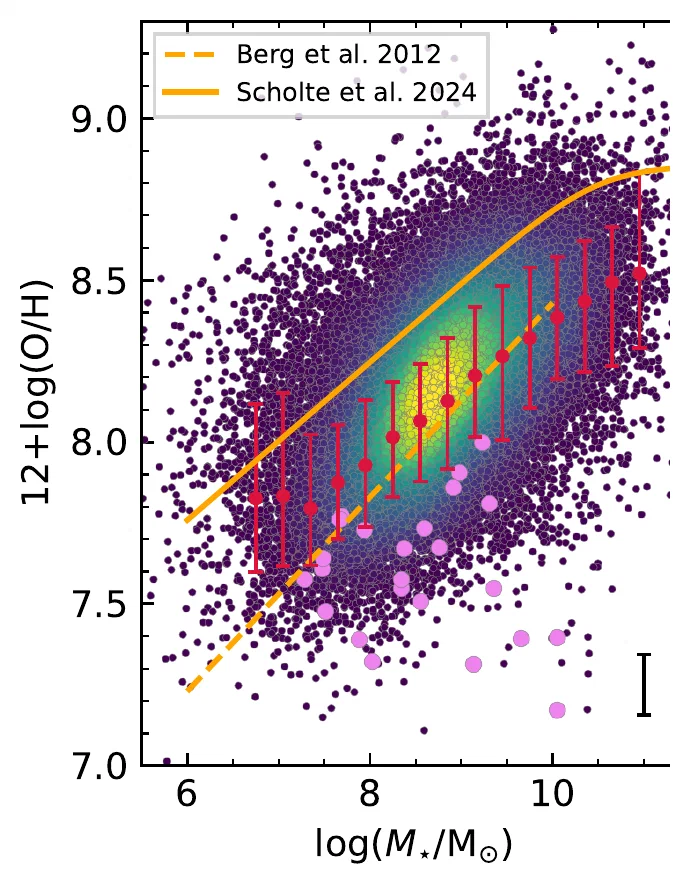
Direct metallicities for 50,000 galaxies
The most reliable way to measure a galaxy’s metallicity uses faint “auroral” emission lines that reveal the temperature of its ionized gas, but those lines are faint and hard to detect. With DESI we measured direct abundances of nitrogen, oxygen, neon, sulfur, and argon for 49,959 galaxies, mapping the mass-metallicity relation over five orders of magnitude in stellar mass and finding the two most metal-poor star-forming galaxies known in the nearby universe.
Selected Papers
- DESI Discovery of the Two Most Metal-Poor Star-Forming Galaxies in the Nearby Universe
Lead author
J. Moustakas, D. Scholte et al. 2026, to be submitted to The Astrophysical Journal - Electron temperature relations and the direct N, O, Ne, S, and Ar abundances of 49 959 star-forming galaxies in DESI data release 2
D. Scholte, F. Cullen, J. Moustakas et al. 2026, MNRAS, 551, 1381 ADS arXiv DOI - The atomic gas sequence and mass-metallicity relation from dwarfs to massive galaxies
D. Scholte, A. Saintonge, J. Moustakas et al. 2024, MNRAS, 535, 2341–2356 ADS arXiv DOI - Dust Extinction and Metallicities of Star-forming Lyα Emitting Galaxies at Low Redshift
S. Finkelstein, S. Cohen, J. Moustakas et al. 2011, ApJ, 733, 117 ADS arXiv DOI - Optical Spectroscopy and Nebular Oxygen Abundances of the Spitzer/SINGS Galaxies
Lead author
J. Moustakas, R. C. Kennicutt, Jr., C. Tremonti et al. 2010, ApJS, 190, 233–266 ADS arXiv DOI - Integrated Nebular Abundances of Disk Galaxies
Lead author
J. Moustakas & R. C. Kennicutt, Jr. 2006, ApJ, 651, 155–166 ADS arXiv DOI