Star Formation and Feedback
Star formation is the process of converting cold gas (mostly hydrogen and helium) into new stars powered by thermonuclear fusion. The most massive stars then inject radiative and mechanical feedback into the surrounding interstellar medium through stellar winds and, at the end of their lives, powerful supernova explosions, which can affect future episodes of star formation. Supermassive black holes can also be a source of feedback at various stages of their growth.
Through detailed observations of both nearby and distant galaxies, my work aims to calibrate how we measure star formation in galaxies, and to understand how feedback from massive stars and black holes regulates it.
Highlights
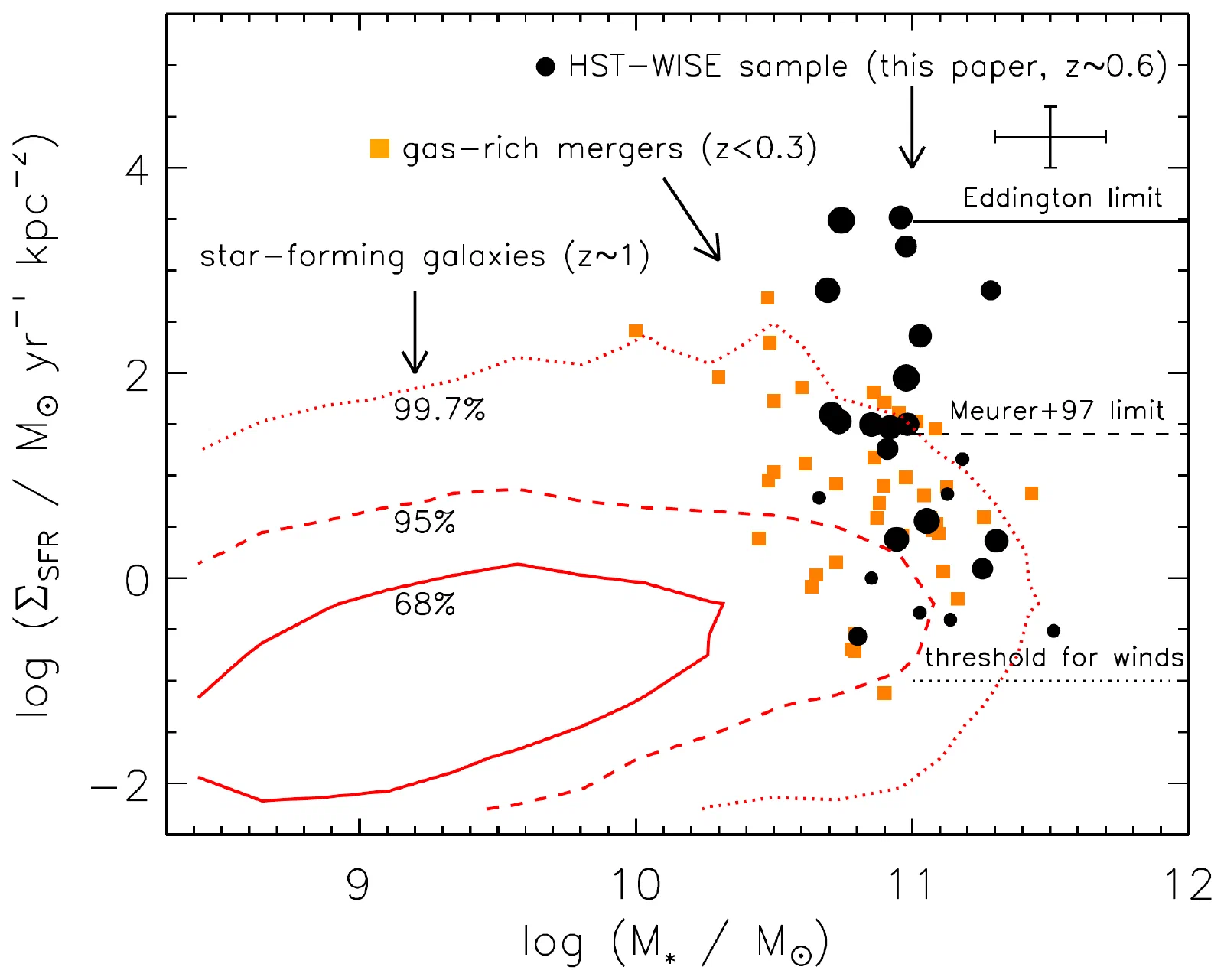
Compact starbursts can launch 1000 km/s winds without a black hole
We discovered outflows faster than 1000 km/s in massive post-starburst galaxies at z≈0.6 (Tremonti et al. 2007), speeds usually attributed to feedback from an accreting black hole. Hubble imaging shows that the star formation in these galaxies is extraordinarily compact, approaching the Eddington limit set by radiation pressure on dust. Radiation and supernovae from the compact starburst alone can drive the winds.
Selected Papers
- DESI Emission-line Galaxies: Unveiling the Diversity of [O II] Profiles and Its Links to Star Formation and Morphology
T. Lan, J. Prochaska, J. Moustakas et al. 2024, ApJ, 977, 225 ADS arXiv DOI - Compact Starburst Galaxies with Fast Outflows: Central Escape Velocities and Stellar Mass Surface Densities from Multiband Hubble Space Telescope Imaging
A. Diamond-Stanic, J. Moustakas, P. Sell et al. 2021, ApJ, 912, 11 ADS arXiv DOI - Calibration of Ultraviolet, Mid-infrared, and Radio Star Formation Rate Indicators
M. Brown, J. Moustakas, R. C. Kennicutt, Jr. et al. 2017, ApJ, 847, 136 ADS arXiv DOI - Galaxies Probing Galaxies at High Resolution: Co-rotating Gas Associated with a Milky Way Analog at z=0.4
A. Diamond-Stanic, A. Coil, J. Moustakas et al. 2016, ApJ, 824, 24 ADS arXiv DOI - Calibrating the Star Formation Rate at z∼1 from Optical Data
N. Mostek, A. Coil, J. Moustakas et al. 2012, ApJ, 746, 124 ADS arXiv DOI - High-velocity Outflows without AGN Feedback: Eddington-limited Star Formation in Compact Massive Galaxies
A. Diamond-Stanic, J. Moustakas, C. Tremonti et al. 2012, ApJL, 755, 26 ADS arXiv DOI - Enhanced Dense Gas Fraction in Ultraluminous Infrared Galaxies
S. Juneau, D. Narayanan, J. Moustakas et al. 2009, ApJ, 707, 1217–1232 ADS arXiv DOI - Active Galactic Nuclei and the Truncation of Star Formation in K+A Galaxies
M. Brown, J. Moustakas, N. Caldwell et al. 2009, ApJ, 703, 150–158 ADS arXiv DOI - The Discovery of 1000 km s-1 Outflows in Massive Poststarburst Galaxies at z=0.6
C. Tremonti, J. Moustakas, & A. Diamond-Stanic 2007, ApJL, 663, L77–L80 ADS arXiv DOI - Optical Star Formation Rate Indicators
Lead author
J. Moustakas, R. C. Kennicutt, Jr., & C. Tremonti 2006, ApJ, 642, 775–796 ADS arXiv DOI