The First Galaxies
Massive galaxy clusters act as natural telescopes: their gravity magnifies the light of galaxies far behind them. Using Hubble Space Telescope observations of lensing clusters, I have searched for some of the most distant galaxies known, which formed within the first few hundred million years after the Big Bang.
Highlights
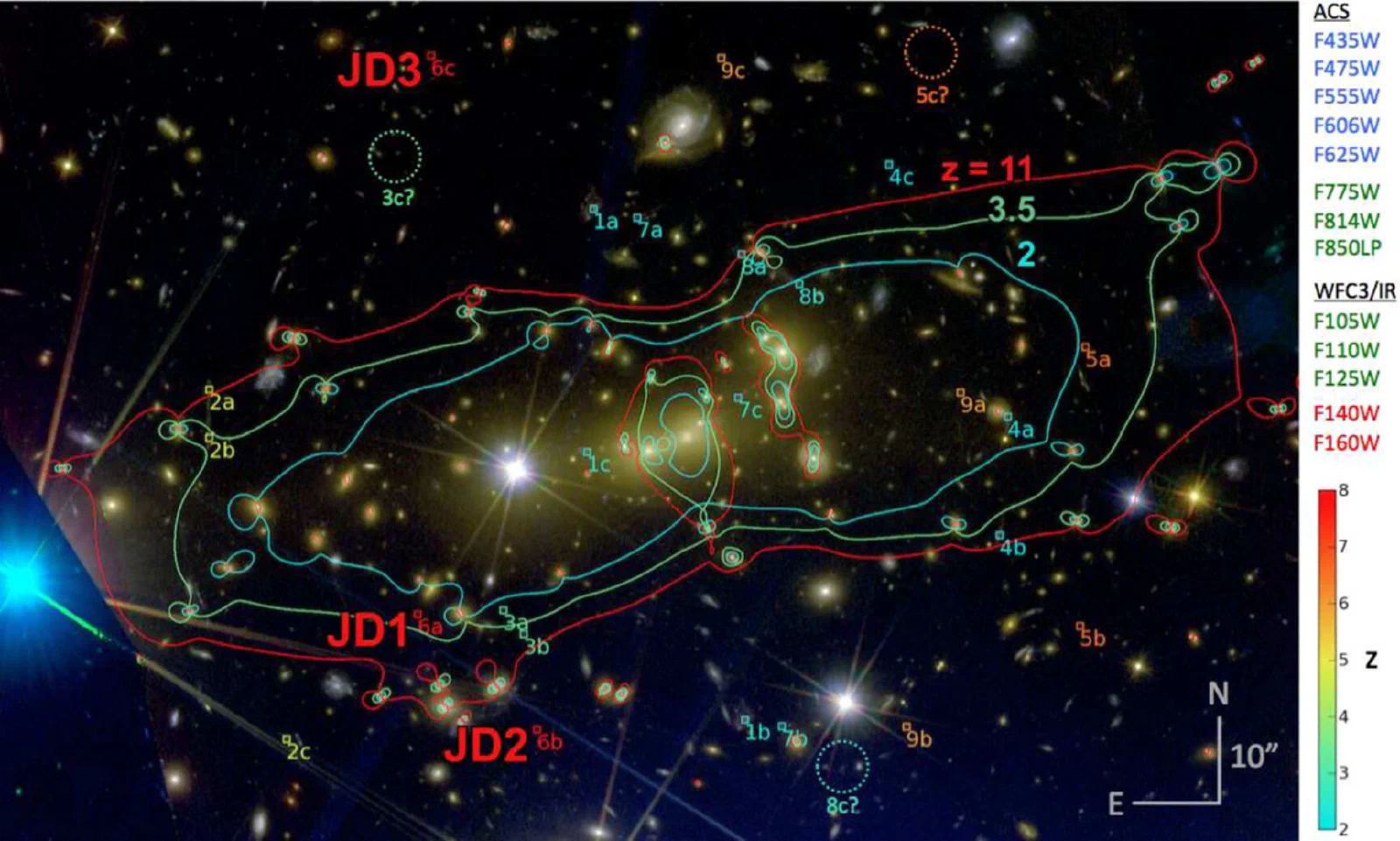
A galaxy seen 400 million years after the Big Bang
In Hubble imaging from the CLASH survey, we found three magnified images of MACS0647-JD, a galaxy at z≈11 lensed by a massive foreground cluster. When it was announced, MACS0647-JD was the most distant galaxy candidate known.
Selected Papers
- A Census of Star-forming Galaxies in the z∼9–10 Universe based on HST+Spitzer Observations over 19 Clash Clusters: Three Candidate z∼9–10 Galaxies and Improved Constraints on the Star Formation Rate Density at z∼9.2
R. Bouwens, L. Bradley, (J. Moustakas, 21st coauthor) et al. 2014, ApJ, 795, 126 ADS arXiv DOI - Young Galaxy Candidates in the Hubble Frontier Fields. I. A2744
W. Zheng, X. Shu, J. Moustakas et al. 2014, ApJ, 795, 93 ADS arXiv DOI - CLASH: Three Strongly Lensed Images of a Candidate z ≈ 11 Galaxy
D. Coe, A. Zitrin, (J. Moustakas, 15th coauthor) et al. 2013, ApJ, 762, 32 ADS arXiv DOI - CLASH: Discovery of a Bright z∼6.2 Dwarf Galaxy Quadruply Lensed by MACS J0329.6-0211
A. Zitrin, J. Moustakas, L. Bradley et al. 2012, ApJL, 747, 9 ADS arXiv DOI